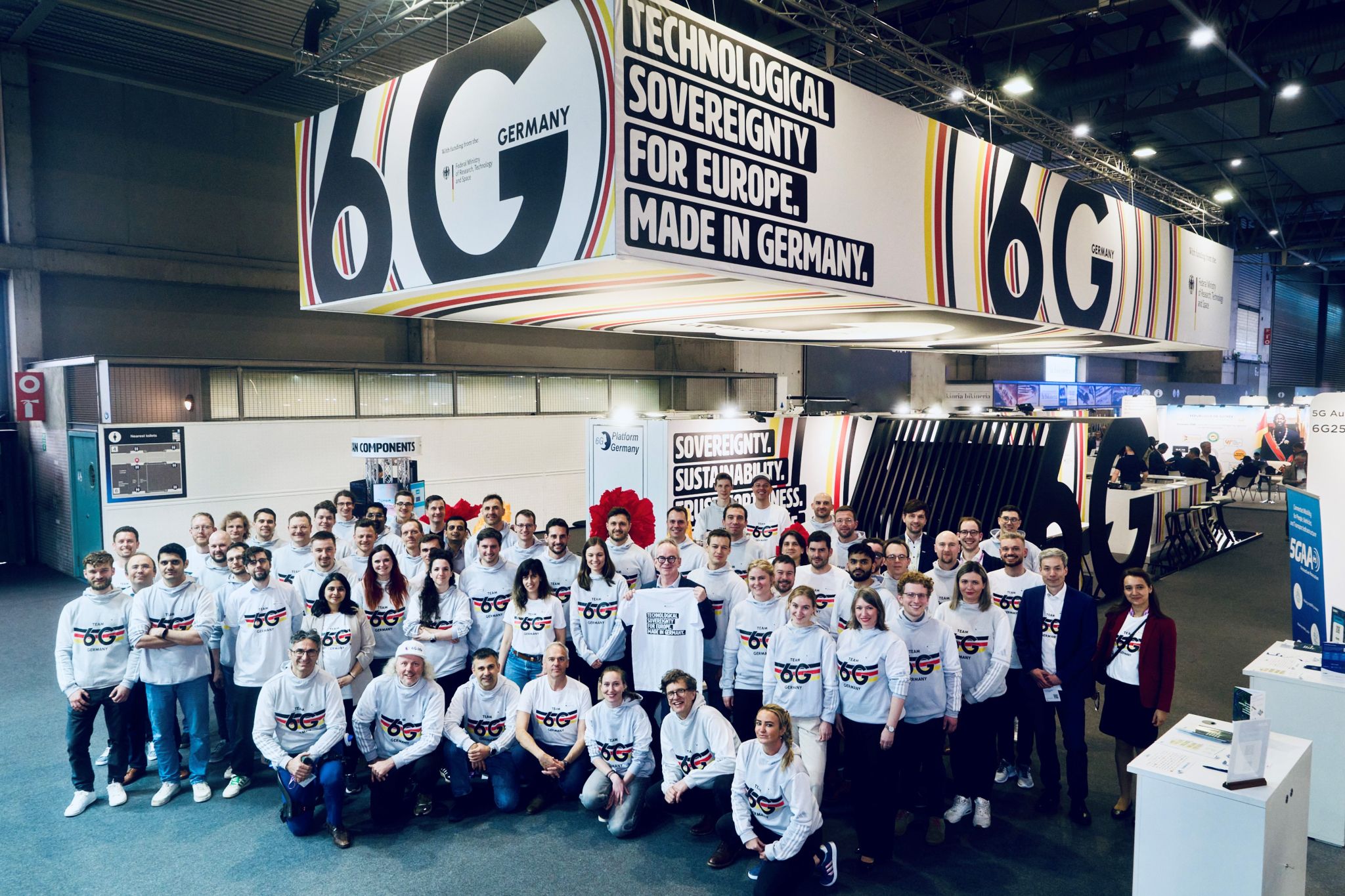
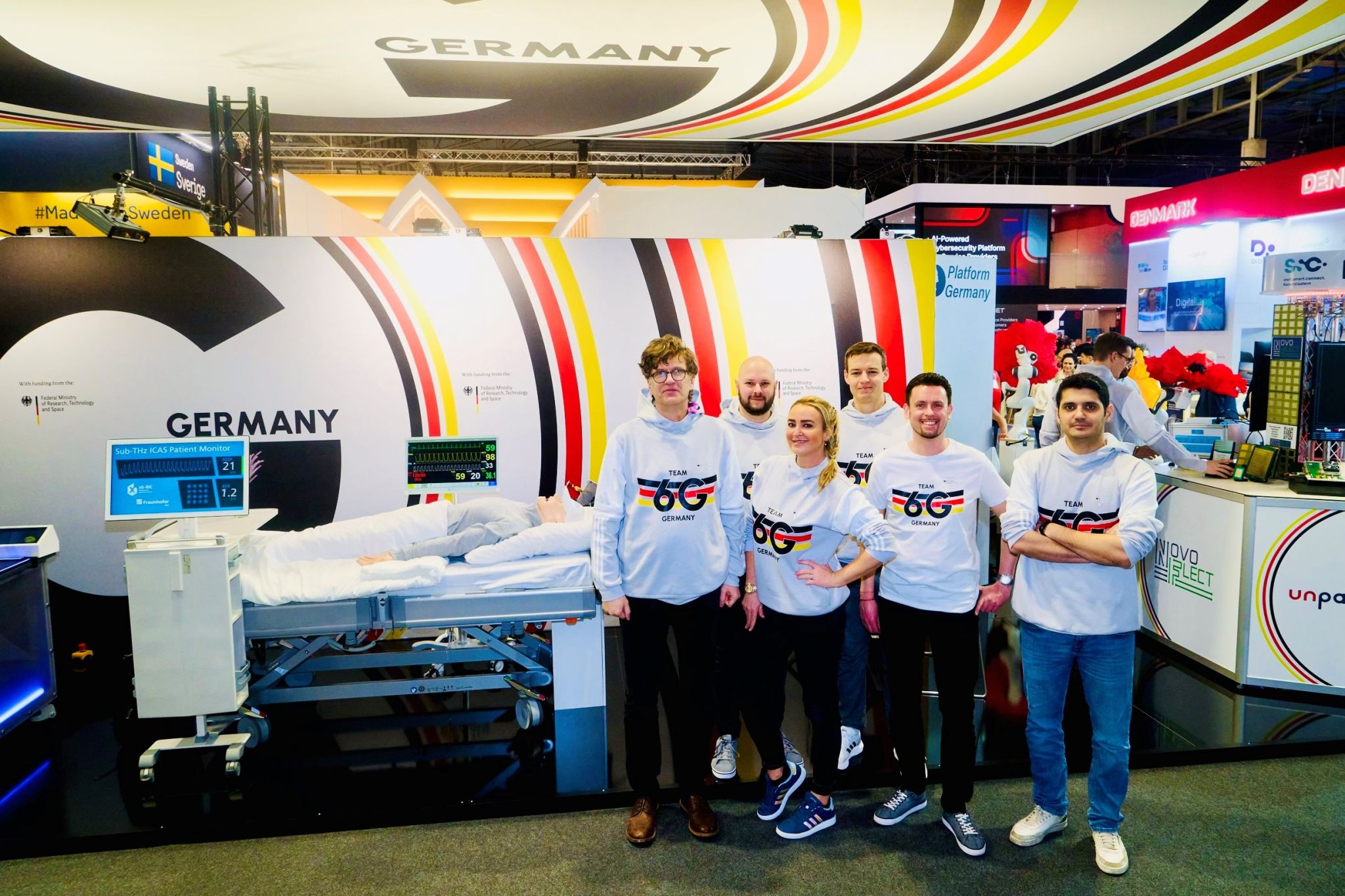
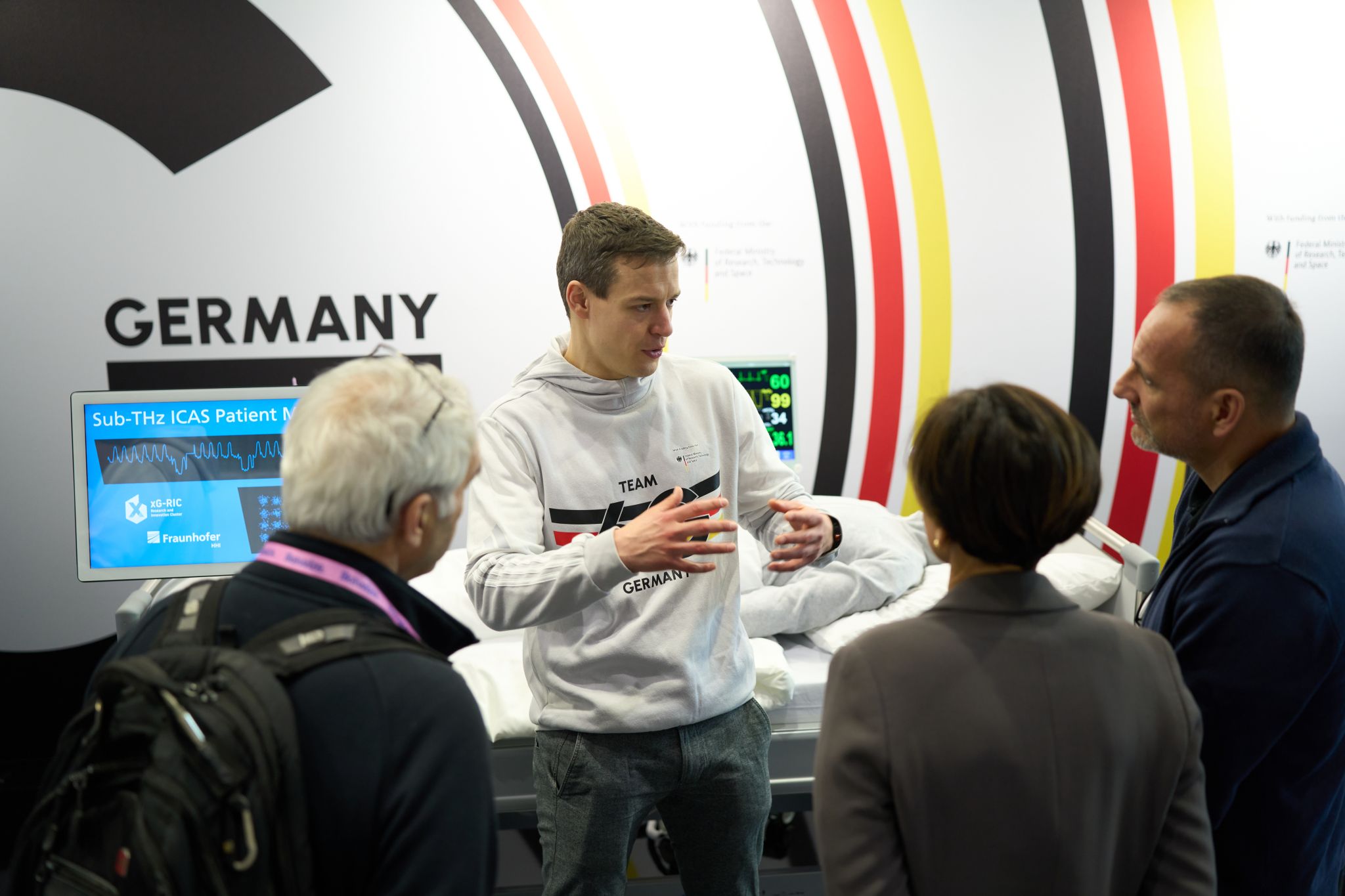
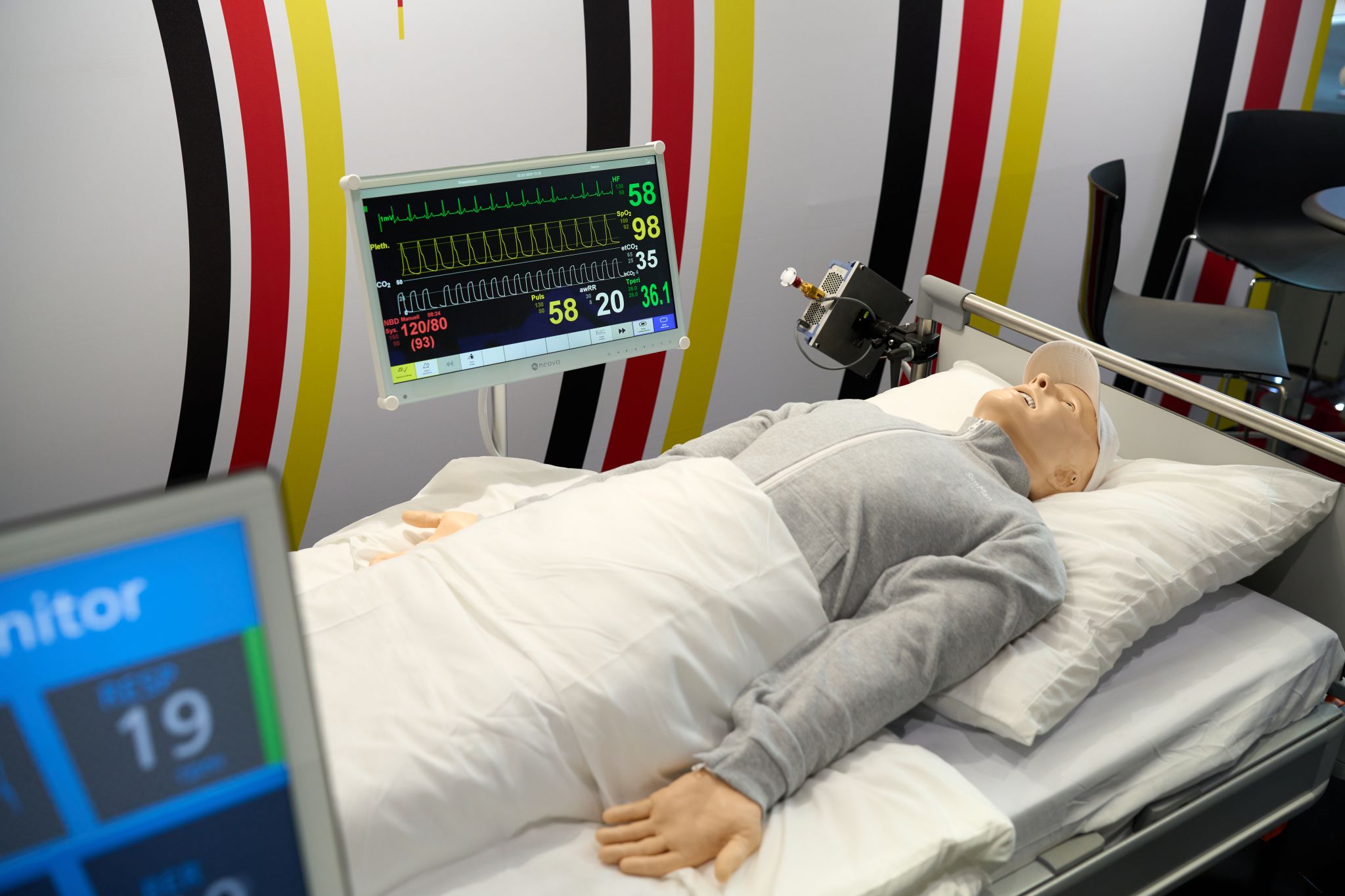
At Mobile World Congress in Barcelona, xG‐RIC showcased how next‐generation 6G technologies can directly benefit the healthcare sector. Our live demonstrator combines sub‐THz communication with Integrated Sensing and Communication (ISAC) to enable contactless patient monitoring in a realistic hospital scenario.
Operating in the sub‐THz range at the booth of the German 6G‐Platform (Hall 6, Booth 6F10), the system delivers approximately 5 Gbit/s while simultaneously measuring a patient’s respiration. This fusion of high‐rate communication and precise sensing demonstrates how 6G will enable connected, patient‐centric care environments.
As the Technology Transfer Hub for Medicine and Mobility of the Future, xG‐RIC drives 6G technologies from research into real‐world applications. Our work includes advancing core 6G components, developing energy‐efficient communication and AI infrastructures, building proof‐of‐concept demonstrators, contributing to ITU and 3GPP standardization, and collaborating closely with industry, startups, and societal stakeholders.
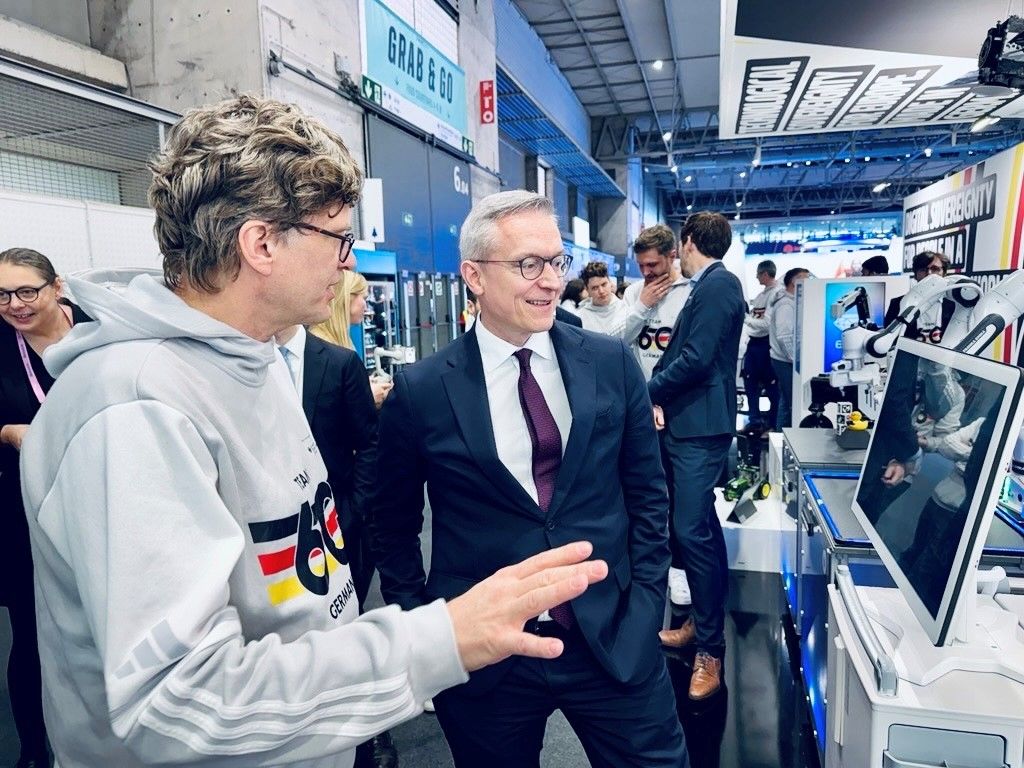
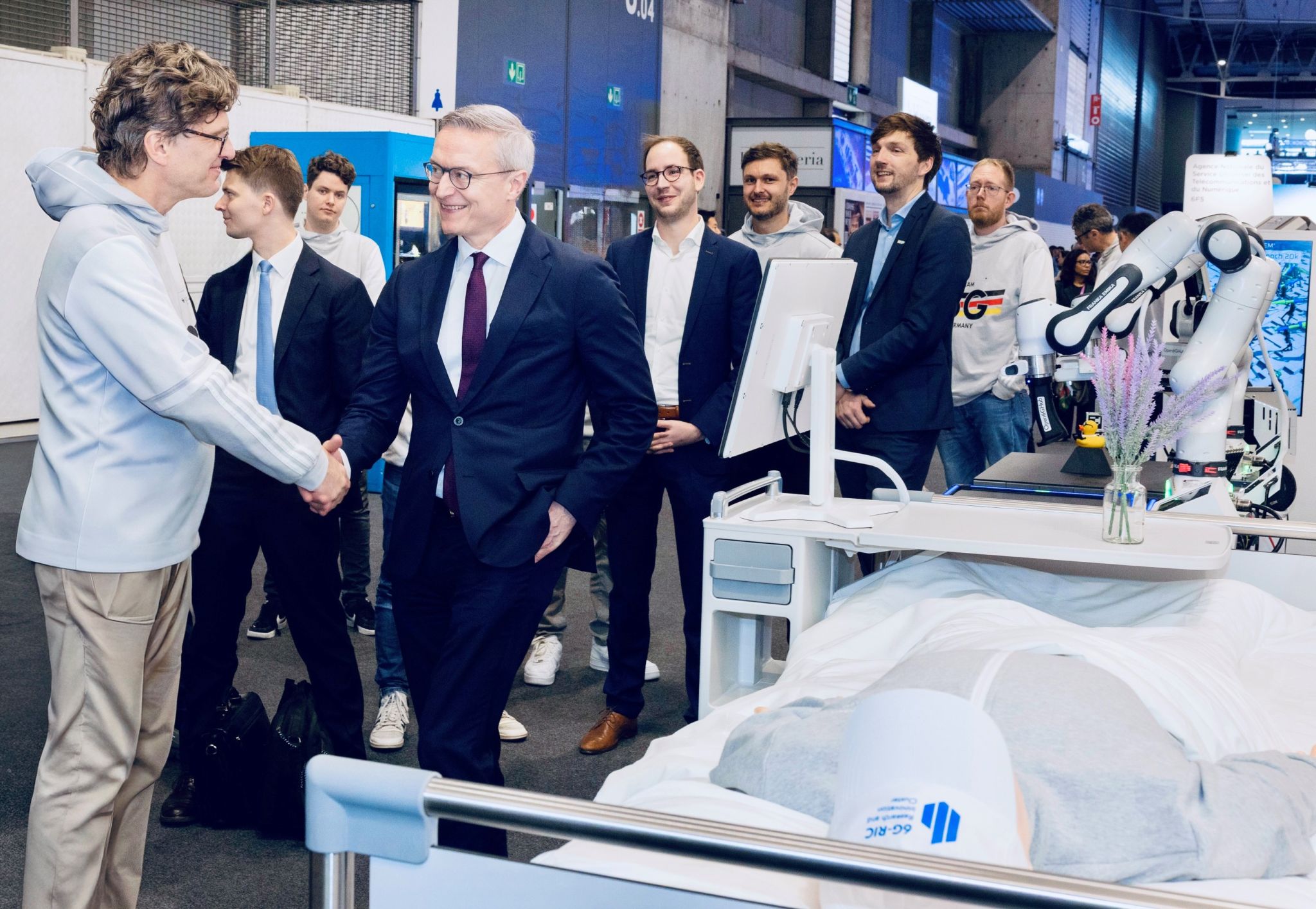
Federal Minister for Digital Transformation and Government Modernization, Karsten Wildberger, visited the German 6G‐Platform booth to explore how 6G innovations are entering the economy. Prof. Slawomir Stanczak coordinator of xG-RIC, presented the demonstrator, highlighting its ability to achieve ~5 Gbit/s in the sub‐THz range while performing real‐time respiration monitoring.
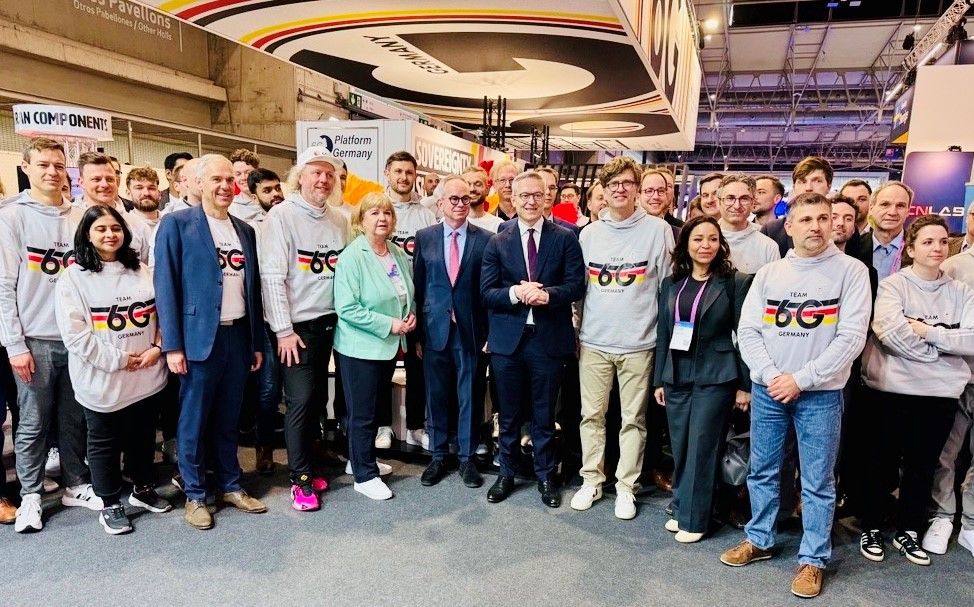
xG‐RIC accelerates the practical adoption of 6G in areas such as integrated sensing and communication, intelligent networks, edge inference, next‐generation multi‐antenna systems, and AI‐driven radio access. Together with the transfer hubs 6G‐life, 6GEM+, and Open6G Hub, we strengthen Germany’s coordinated national 6G innovation ecosystem.
xG-RIC brings together leading partners including Deutsches Herzzentrum der Charité (DHZC), Deutsches Zentrum für Luft-und Raumfahrt e.V., FAU Erlangen-Nürnberg, Fraunhofer IAF, Fraunhofer IIS, Fraunhofer Heinrich Hertz Institute HHI, IHP – Leibniz Institute for High Performance Microelectronics, Technische Universität Berlin and Technische Universität Braunschweig. Funded by the Bundesministerium für Forschung, Technologie und Raumfahrt, we contribute to shaping the next generation of communication technologies for a connected society.


At Mobile World Congress in Barcelona, xG‐RIC showcased how next‐generation 6G technologies can directly benefit the healthcare sector. Our live demonstrator combines sub‐THz communication with Integrated Sensing and Communication (ISAC) to enable contactless patient monitoring in a realistic hospital scenario.
Operating in the sub‐THz range at the booth of the German 6G‐Platform (Hall 6, Booth 6F10), the system delivers approximately 5 Gbit/s while simultaneously measuring a patient’s respiration. This fusion of high‐rate communication and precise sensing demonstrates how 6G will enable connected, patient‐centric care environments.
As the Technology Transfer Hub for Medicine and Mobility of the Future, xG‐RIC drives 6G technologies from research into real‐world applications. Our work includes advancing core 6G components, developing energy‐efficient communication and AI infrastructures, building proof‐of‐concept demonstrators, contributing to ITU and 3GPP standardization, and collaborating closely with industry, startups, and societal stakeholders.
Federal Minister for Digital Transformation and Government Modernization, Karsten Wildberger, visited the German 6G‐Platform booth to explore how 6G innovations are entering the economy. Prof. Slawomir Stanczak coordinator of xG-RIC, presented the demonstrator, highlighting its ability to achieve ~5 Gbit/s in the sub‐THz range while performing real‐time respiration monitoring.
xG‐RIC accelerates the practical adoption of 6G in areas such as integrated sensing and communication, intelligent networks, edge inference, next‐generation multi‐antenna systems, and AI‐driven radio access. Together with the transfer hubs 6G‐life, 6GEM+, and Open6G Hub, we strengthen Germany’s coordinated national 6G innovation ecosystem.
xG-RIC brings together leading partners including Deutsches Herzzentrum der Charité (DHZC), Deutsches Zentrum für Luft-und Raumfahrt e.V., FAU Erlangen-Nürnberg, Fraunhofer IAF, Fraunhofer IIS, Fraunhofer Heinrich Hertz Institute HHI, IHP – Leibniz Institute for High Performance Microelectronics, Technische Universität Berlin and Technische Universität Braunschweig. Funded by the Bundesministerium für Forschung, Technologie und Raumfahrt, we contribute to shaping the next generation of communication technologies for a connected society.


Funded BY

Supported BY

Info
Contact
Fraunhofer Heinrich-Hertz-Institut, HHI
Prof. Dr.-Ing. Slawomir Stanczak
Einsteinufer 37
D–10587 Berlin
Links

Funded BY

Supported BY

Info
Fraunhofer Heinrich-Hertz-Institut, HHI
Prof. Dr.-Ing. Slawomir Stanczak
Einsteinufer 37
D–10587 Berlin
Contact
Links